Vice Dean, Faculty of Information Technology
Faculty of Information Technology, University of Science, VNU-HCM
Faculty of Information Technology · University of Science, VNU-HCM
Vice Dean, Faculty of Information Technology
Lecturer and researcher in data mining, machine learning, big data, and knowledge graphs, with recent work focused on knowledge graph embedding, link prediction, temporal reasoning, and multimodal knowledge graphs.
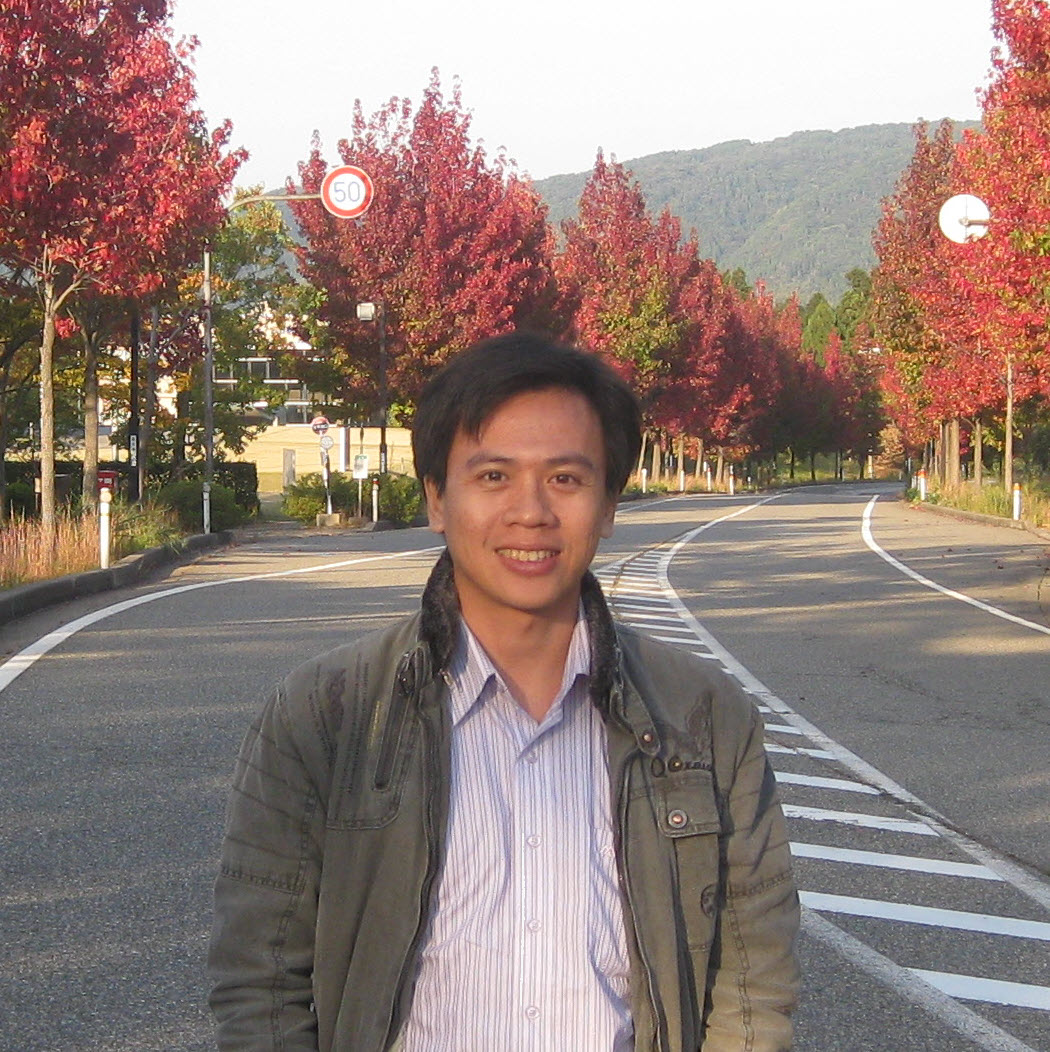
About
Thanh Le is a lecturer in the Computer Science Department, Faculty of Information Technology, University of Science, VNU-HCM. His research focuses on data mining, knowledge graphs, big data, machine learning, and graph-based reasoning.
Experience
Faculty of Information Technology, University of Science, VNU-HCM
Department of Computer Science, Faculty of Information Technology, University of Science, VNU-HCM
Computer Science Department, Faculty of Information Technology, University of Science, VNU-HCM
Computer Science Department, Faculty of Information Technology, University of Science, VNU-HCM
DTV Team, Renesas Design Vietnam Company, Ho Chi Minh City, Vietnam
Research
Embedding models, link prediction, completion, and temporal knowledge graph reasoning.
Graph neural networks, relational reasoning, tensor decomposition, and quaternion representations.
Data mining, deep learning, representation learning, and recommender systems.
Scalable data-driven methods for intelligent systems and educational applications.
Research timeline
A Google Scholar-inspired timeline combined with an academic CV layout, highlighting the evolution of research directions without citation counts.
Recent work focuses on temporal knowledge graph reasoning, multimodal knowledge graph completion, bicomplex/quaternion representations, tensor decomposition, and graph neural reasoning.
This period emphasizes interaction-rich embedding models, Fourier-enhanced representations, graph transformers, contrastive learning, and interpretable graph neural networks.
The research agenda expands from embedding methods to hyperplanes, rotations, complex/quaternion spaces, graph neural networks, and applied AI systems in education and healthcare.
Earlier work includes MOOC recommendation, chatbot response filtering, sparse network representation learning, next-purchase prediction, and detecting hidden semantic relations in geographic data.
Teaching
Publications
Contact
Department of Computer Science, Faculty of Information Technology, University of Science, VNU-HCM.